The Silent Watchers: An Introduction to Passive Radar (Part 1 of 4)
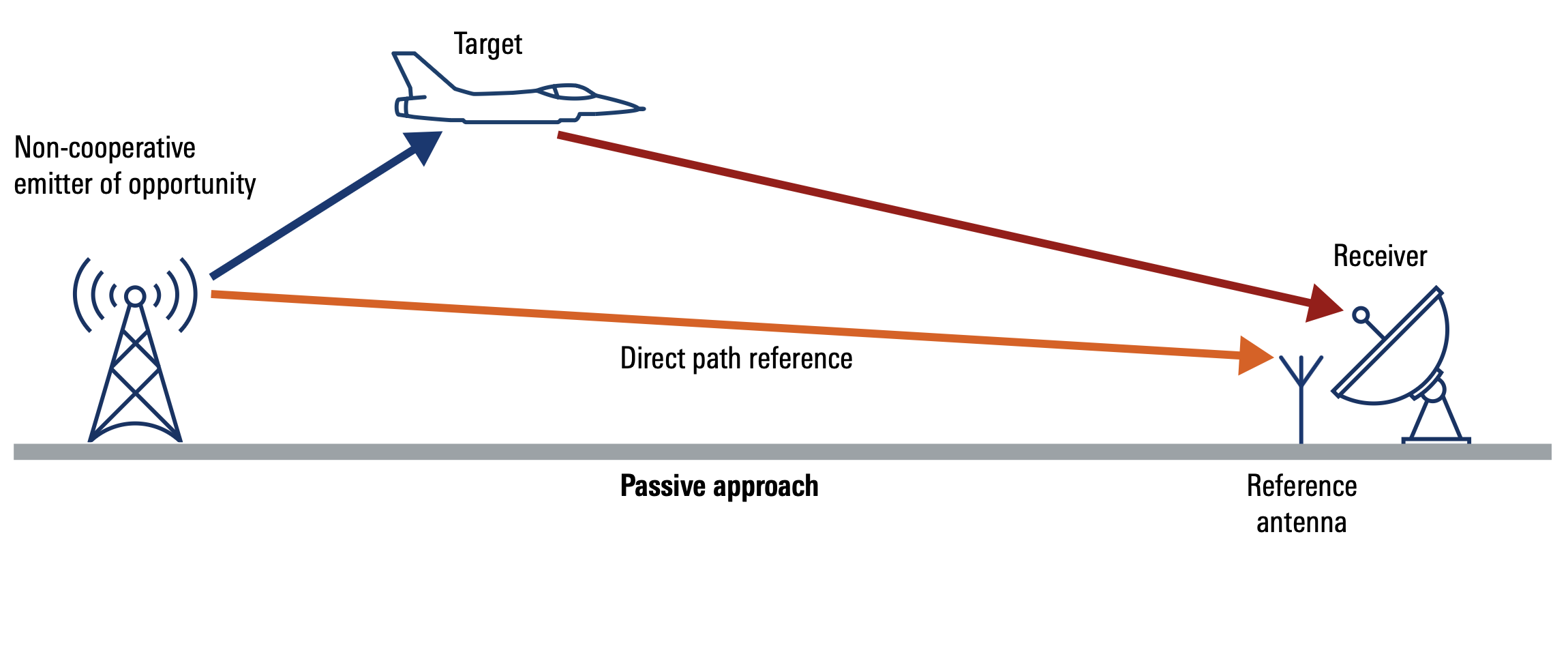
Imagine detecting aircraft without transmitting a single signal. Passive radar systems accomplish this remarkable feat by “borrowing” existing broadcast transmissions—your FM radio, digital TV, or cellular signals—and using them to track targets. Unlike traditional radar that broadcasts its own signal and listens for echoes, passive radar operates silently, using signals already in the air.
A Brief History
The concept isn’t new. In 1935, Robert Watson-Watt demonstrated the first passive radar by detecting aircraft using BBC radio transmissions at Daventry. During World War II, Germany’s Klein Heidelberg receivers exploited British radar signals to detect Allied bombers. After decades of dormancy, NATO revived passive radar in the 1990s, recognizing its potential against stealth aircraft—which are designed to deflect active radar but can’t hide from signals bouncing off them at different angles.
Why It Matters Today
Passive radar offers compelling advantages that have made it commercially viable:
Cost-effective operation: Systems cost 10-50× less than traditional radar. No high-power transmitter means lower capital costs and minimal power consumption.
Covert surveillance: Without emissions, passive radar is virtually undetectable. Adversaries can’t locate or jam what they can’t see transmitting.
Anti-stealth capability: The bistatic geometry (separate transmitter and receiver locations) defeats stealth design, which relies on reflecting signals away from their source.
Operational today: Commercial systems are deployed worldwide—Hensoldt’s TwinVis in Germany, ERA’s Vera-NG in the Czech Republic, and Silentium Defence’s Maverick in Australia.
Enhanced with AI: Modern deployments fuse data from multiple passive radar sensors with AI pattern-matching algorithms, further improving detection accuracy and reducing false alarms.
The Evolution Continues
Passive radar systems today primarily use DVB-T broadcast signals. But broadcast technology is evolving. Next-generation TV standards like ATSC 3.0—now operational in South Korea and expanding across the United States—offer more flexible signal structures. These advanced systems may enable significant improvements: larger coverage areas without false targets, configurable patterns for different missions, and better urban performance.
As this series will explore, the convergence of modern broadcast technology and passive sensing creates new commercial opportunities. Companies developing surveillance and sensing applications can leverage existing broadcast infrastructure—no need to deploy expensive transmitters. This opens doors for startups, defense contractors, and technology firms to build cost-effective radar systems for civilian markets: airport security, border monitoring, critical infrastructure protection, and beyond.
Next in this series: What signals can we actually use? We’ll explore the various “emitters of opportunity” that make passive radar possible, from FM radio to satellites, and why broadcast TV has emerged as the gold standard.
P.S. For deeper technical background, see Rohde & Schwarz’s Introduction to Passive Radar Systems.